
Monetizing YouTube is possible without millions of fans. Small creators can make good money by focusing on specific topics. They should also be honest and engage well with their audience.
There are ways to make money on YouTube that don’t need ads. Options like affiliate marketing, sponsorships, Patreon, and selling products directly are available from the start.
Make sure viewers can easily find links by testing them on different browsers. It’s more important to focus on watch time and comments than just getting more subscribers. This way, you can earn money from your videos without needing a huge audience.
This article explains how to make money from YouTube without a huge following.
Key Notes;
- Small, engaged audiences can convert better than large, passive ones.
- YouTube monetization without ads is realistic through affiliates and memberships.
- Set up off-platform funnels (Patreon, Gumroad) to boost small YouTube channel income.
- Ensure external links and widgets work in different browsers for maximum conversions.
- Focus on niche content and consistent value to grow passive income from YouTube videos.
Why monetization on small YouTube channels is realistic and valuable
Small channels connect with tight-knit communities quickly. Creators in niches like hobbies or local interests get real feedback. This builds trust, turning viewers into buyers or subscribers.
Understanding niche audiences and engaged micro-communities
Creators who focus on specific topics get more engagement. Viewers in these communities share tips and buy more. This makes endorsements feel personal and relevant.
Brands like Skillshare and Audible prefer targeted ads. Small channels can match offers to what viewers want. This leads to more valuable interactions per view.
How small channels convert better per viewer than large channels
A focused audience makes each view count more. One engaged viewer can earn more than many on a big channel. This is how small channels make more money.
Creators can use videos to get viewers to sign up or buy. Treating videos as lead generators boosts long-term value. This supports sustainable monetization strategies.
Overview of alternative monetization paths beyond AdSense
AdSense alone can take a long time for small creators. Options include affiliate programs, sponsorships, Patreon, digital sales, and consulting. These let creators test what works and grow income without waiting for YPP.
Build a content backlog as a portfolio for sponsors. It also builds trust with buyers. This helps with monetization and keeps income streams flowing as the channel grows.
how to make money from youtube without a huge following
Small channels can do well by turning viewers into customers. Use video descriptions and clear CTAs to send viewers to products or landing pages. Focus on keeping viewers engaged to boost your earnings.
Using YouTube as a traffic and conversion engine
Think of YouTube as a place where people search and find things. A short tutorial or honest review can lead viewers to buy. Add a lead magnet in the description to get emails for future offers.
Use end screens and cards to guide viewers to more videos or a landing page. Track which videos get clicks and make more of those. This helps with affiliate marketing by pairing content with links and CTAs.
Setting realistic income expectations for small channels
Starting ad revenue is often small. Creators usually start with affiliate commissions, Patreon, or sponsorships. Be patient and keep creating content regularly.
Look at creators like Epic Meal Time for how they grow their income. For most, income starts with small commissions, not big ad checks. Use your earnings to improve your videos and SEO to increase your RPM over time.
Case examples and short success stories of micro-influencers
A cooking channel shared short recipes with affiliate links for tools. A small but loyal audience bought tools, then a downloadable recipe pack. That pack made more money than ad revenue from thousands of views.
A woodworking creator made short clips and sold plans through email follow-ups. One-time affiliate sales turned into monthly courses. These stories show how to grow revenue on YouTube by focusing on niche value and direct offers.
Follow a simple loop: publish niche tutorials, add affiliate links, capture emails, and offer higher-margin products later. These steps help make money on YouTube without needing a huge following. They use earning from YouTube views and affiliate marketing tips.
YouTube Partner Program and ad revenue tactics for growing channels
To start making money on YouTube, you need to meet certain goals. You must have 1,000 subscribers and 4,000 watch hours in a year. You also need to link an AdSense account and follow YouTube’s rules.
Eligibility requirements mean small creators should focus on consistent uploads, improving watch time, and cleaning up policy risks before expecting ad income. Past thresholds have shifted over time, so plan for steady growth.
Ad formats and niche targeting shape earnings more than raw views. Display, overlay, skippable and unskippable video ads, plus bumper ads, pay differently. More intrusive formats often yield higher CPMs but can hurt retention. RPM CPM niche targeting matters: finance, business, insurance, and tech typically draw higher bids than general entertainment.
Creators do not receive full ad spend. YouTube shares revenue with creators, which affects take-home pay. Optimizing titles, thumbnails, and session watch time raises the effective RPM when advertisers value your audience.
When ads make sense depends on scale and strategy. For many small channels, ad revenue is supplementary after YPP approval. Prioritize higher-margin paths such as affiliate promotions, direct product sales, and memberships until views and RPM justify relying on ads.
Smart youtube ad revenue tactics include testing video lengths, placing natural ad-friendly breaks, and using niche-focused content that attracts higher CPM advertisers. Track RPM trends by video and double down on formats that sustain viewer retention.
If your target is youtube monetization without ads, build funnels that drive traffic to Patreon, Gumroad, or an email list. Use ads to top up revenue, not as the only plan, until you reach steady viewership and stable RPM CPM niche targeting results.
| Factor | Impact on Earnings | Action for Small Creators |
|---|---|---|
| Eligibility (YPP) | Allows ad monetization and channel features | Focus on 1,000 subs, 4,000 watch hours, policy compliance |
| Ad format mix | Changes CPM; unskippable and bumper often pay more | Experiment; favor formats that keep retention high |
| Niche targeting | Drives advertiser bids and RPM | Target high-value niches like finance or tech when feasible |
| Revenue split | YouTube share reduces creator payout | Combine ads with affiliate and direct sales to boost margins |
| Alternative monetization | Can out-earn ads for small audiences | Prioritize memberships, courses, sponsorships early |
Affiliate marketing on YouTube: high-impact strategies for small audiences
Affiliate marketing is a good way for creators to earn money, even with a small audience. They can make money by sharing focused offers, honest reviews, and using tracked links or promo codes. This method works well for creators who value trust and relevance.
Choosing affiliate programs that fit your niche and audience
First, match products to what your viewers need. Amazon Associates is great for everyday items. For niche products, try ShareASale, CJ, and Impact. Digital products like courses or software often have higher commissions.
Know your audience well—age, gender, location, and how long they watch. It’s better to have a niche that converts well than high commission rates. Always track your results and drop programs that don’t work.
How to present affiliate offers naturally and build trust
Blend offers into your content, like tutorials, reviews, and comparisons. Show how products work to make them more appealing. Being honest about pros and cons builds trust and increases earnings over time.
Always tell your viewers about your relationship with the product, as the FTC requires. Mention it in the video and description clearly. A trustworthy approach can boost clicks and repeat purchases.
Placement tactics: video content, descriptions, pinned comments, and cards
Use different places to promote products without being too pushy. Talk about the product in your video and show it in action. Add a clear call to action in your description and pin a key link in comments.
Cards and end screens can lead viewers to more videos or affiliate pages. Keep links short and use UTM tags when you can. Prefer promo codes when tracking is limited.
Here’s a comparison to help small creators choose the best affiliate channel. The table shows typical commission rates, audience fit, and conversion strength for each type.
| Program Type | Typical Commission | Best For | Conversion Strength for Small Channels |
|---|---|---|---|
| Amazon Associates | 1%–10% | Everyday consumer goods, gadgets, accessories | Good due to trust and familiar checkout |
| Affiliate Networks (ShareASale, CJ, Impact) | 5%–30% | Niche physical products, emerging brands | Strong when niche match is tight |
| Vendor Programs (digital products, SaaS) | 20%–50%+ or flat fees | Courses, plugins, software, digital tools | Very strong for engaged audiences with need |
| Coupon/Deal Sites and Promo Codes | Varies; flat or percentage | Price-sensitive shoppers, seasonal campaigns | High when exclusives or timed offers are used |
Use these tips to improve your affiliate marketing on YouTube. Focus on making offers better, measuring results, and increasing your small channel’s income. By being relevant and trustworthy, you can earn money without needing a huge following.
Sponsorships and brand deals for micro-influencers
Smaller channels can win sponsorships by showing they fit well with a brand. It’s not just about how many viewers you have. A good media kit with details about your audience and recent views helps.
When you pitch, choose brands that match your content. Start with a simple email or DM. Highlight how you can help the brand, like getting more conversions.
Offer a test campaign first to build trust. Use youtube sponsorship strategies that list what you’ll do, when, and how you’ll measure success.
Focus on what brands value, not just how many subscribers you have. Share your average views, watch time, and how engaged your viewers are. Also, share your audience’s age, location, and interests to show you’re a good fit.
Having a steady stream of content shows brands you’re reliable. This helps them see how much money they might make with you in the long run.
Use platforms and marketplaces to find opportunities. YouTube BrandConnect, FameBit, Grapevine, and GRIN can help. Also, reach out directly to brands and local businesses that might be interested.
Negotiate smartly by bundling your offers. For example, include a main YouTube video, short social clips, and a link in your description. Be open to starting with product-only deals and then asking for more money if you do well.
Below is a quick guide to help you choose the right channels and pricing for small creators.
| Channel | Best use | Typical offer structure | Negotiation tip |
|---|---|---|---|
| YouTube BrandConnect / FameBit | Brand-match campaigns and discovery | Flat fee per integration, sometimes performance bonus | Show recent campaign metrics and a short case study |
| Grapevine | Small to mid-size brand deals | Tiered packages: video + social clips + links | Offer a pilot package with measurable KPIs |
| GRIN | Brands seeking ongoing creator partnerships | Monthly retainers or multi-video contracts | Bundle content series to increase lifetime value |
| Direct outreach (local brands) | Product trials and co-marketing | Product-only to paid, angled to demo or review | Highlight local audience and purchase intent |
Selling digital products and services to build higher-margin revenue
Small creators make more money by selling digital products and services. They don’t just rely on ads. YouTube is great for sending viewers to useful downloads, paid courses, or one-on-one help. This way, they get better leads and turn viewers into paying customers.

Product ideas that sell
Make compact, useful items that fit your niche. E-books and checklists solve problems for your audience. Templates and presets save time for busy users. Online courses offer deep learning and can be priced higher.
Service offers you can package
Creators can sell coaching, consulting, or production services. Editing and social strategy packages are good for video makers. Price services based on time saved and results, not just hourly effort.
Funnels that convert viewers into buyers
Start with a lead magnet that gives quick value, like a free mini-course or video guide. Use it to get emails and start a short nurture sequence with focused offers.
Automate with a reliable stack. Use Teachable, Podia, or Gumroad for courses. Link landing pages to Mailchimp, ConvertKit, or ActiveCampaign for follow-up. Test flows on mobile and desktop to reduce friction.
| Step | Action | Tools | Goal |
|---|---|---|---|
| 1 | Create a lead magnet tied to a video topic | Canva, Google Docs | Lead generation from YouTube |
| 2 | Build a landing page and email capture | Squarespace, Leadpages | Collect emails for nurture |
| 3 | Offer an entry-level product or course | Teachable, Podia | Begin sales cycle for digital products for creators |
| 4 | Upsell coaching or long-form course | Zoom, Calendly | Higher-margin conversions |
| 5 | Retain customers with updates and community | Discord, Facebook Groups | Repeat purchases and referrals |
When selling courses on YouTube, keep it natural and value-first. Use a short demo, clear learning outcomes, and a timed discount to increase urgency. Track conversion rates and refine landing copy based on data.
Passive income from YouTube grows when evergreen products and automated funnels work together. Focus on user experience, fast delivery, and honest promises to build trust and long-term revenue.
Faceless channels, Shorts, and passive income tactics
Faceless formats let creators avoid being on camera. They use voiceovers, animations, and stock footage to make videos fast. This makes it easier to work with others and keeps personal exposure low.
Repurposing content turns one big video into many smaller ones. A long video can become clips, Twitter threads, and Shorts. This way, creators can make more content without working harder.
How to scale
- Create a core video that teaches or solves a clear problem.
- Edit short highlights for YouTube Shorts and social platforms.
- Use templates for thumbnails and descriptions to speed posting.
YouTube Shorts can now help creators earn money. Short videos can lead viewers to longer, money-making videos. In some places, Shorts even share revenue, helping creators earn more.
Shorts can help viewers find new content. A short clip can point to a longer video, increasing watch time and ad earnings. This creates a cycle where Shorts help longer videos make more money.
Evergreen videos are key to making money passively. Tutorials, walkthroughs, and roundups stay useful for years. They attract steady views, clicks, and course sign-ups with little effort.
Repurposing content helps evergreen videos grow. Clip long tutorials into Shorts focused on specific problems. Then, link those Shorts to the full video or a landing page. This brings more traffic over time.
Practical checklist
- Pick topics that solve repeatable problems in your niche.
- Batch-produce long-form content and extract 5–10 Shorts per video.
- Include evergreen affiliate links and a pinned CTA for course sign-ups.
- Track which Shorts send the most traffic and double down on that format.
Together, faceless channels, smart repurposing, and Shorts offer a simple way to earn money on YouTube. This approach is great for creators who want to grow without being on camera all the time.
Traffic redirection and cross-platform monetization
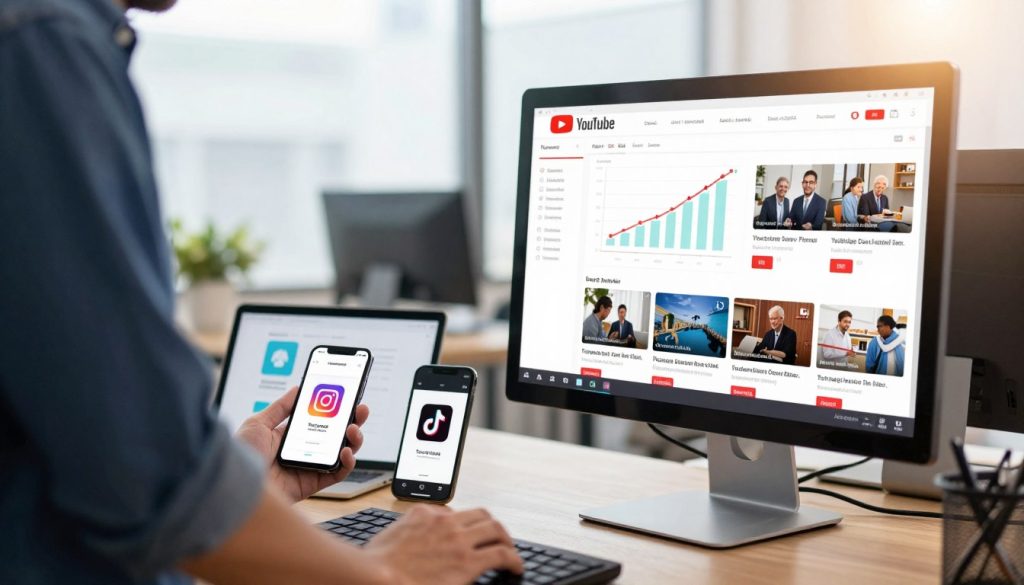
Use YouTube as the main way to sell products and channels. Short, clear prompts in videos guide viewers to membership platforms and stores. This way, viewers can easily support creators and buy products.
Using YouTube to drive audiences to Patreon, Gumroad, Shopify, or your website
Patreon for creators lets dedicated viewers get recurring perks. Offer different benefits like early access or exclusive Q&A to increase value. Selling merchandise on Shopify adds one-time purchases with good profit margins.
For digital goods, gumroad sales from YouTube are best for instant delivery. Place a clear call-to-action in the first 15 seconds and again at the end to increase clicks.
Best practices for CTAs, links, and content that encourages off-YouTube purchases
Use both verbal and on-screen CTAs so viewers see and hear the next step. Put direct links in the top lines of video descriptions and pin a comment with a buy link. Create short landing pages for conversion, with a clear headline and one offer.
Time promotions after teaching something valuable. This boosts conversion rates. Segment offers by audience demographics to match price and format to what viewers can afford and want.
Leveraging social platforms and repurposed clips to amplify reach and sales
Repurpose clips for Instagram, TikTok, and Facebook to reach more people. Tailor each clip to fit each platform’s style. Use social bios and pinned posts to link to membership pages.
Test platform-specific messaging to find the most effective creative. Track results to grow cross-platform monetization from data, not guesswork.
| Goal | Primary Action | Best Channel | Quick Tip |
|---|---|---|---|
| Recurring revenue | Offer membership tiers and exclusive content | Patreon for creators | Highlight a members-only benefit in every video |
| Digital product sales | Sell guides, templates, or courses | Gumroad sales from YouTube | Lead with a free mini-sample to build trust |
| Merchandise and one-time purchases | Create branded apparel and bundles | Shopify or Printful integrations | Offer limited drops to create urgency |
| Audience growth | Repurpose clips with clear CTAs | Instagram, TikTok, Facebook | Match format to platform and include a single link |
| Conversion optimization | Use landing pages and A/B test CTAs | Your website or sales page | Reduce choices to one primary CTA per page |
Conclusion
Small channels can make money by focusing on value, being real, and building a community. By targeting a specific niche, creators gain trust. This trust leads to better earnings per viewer than trying to appeal to everyone.
This article shared ways to make money on YouTube, like using affiliate links, sponsorships, and selling digital products. You can also offer services, start memberships, and increase ad earnings once you’re eligible.
Success on YouTube comes from making good content regularly and seeing it as a way to get more viewers and make money. Create a video library for sponsors, get emails with simple funnels, and share clips on other platforms. This approach makes earning money from YouTube more stable than hoping for one big hit.
Focus on solving problems for your viewers, increase watch time, and try different ways to make money at the same time. Over time, steady earnings and repeat customers add up to a good income. For those wondering how to earn from YouTube without many followers, the key is to focus on a niche, diversify income, and grow slowly.
FAQ
How many followers do you need to start making money off of YouTube?
YouTube’s Partner Program needs 1,000 subscribers and 4,000 watch hours in a year for ad money. But, you can earn sooner with affiliate links, direct sales, or sponsorships. Platforms like Amazon Associates and Patreon help small channels make money without waiting for YPP.
How to get 100 subs in 1 day?
To get 100 subs fast, make content that solves a problem. Use high-contrast thumbnails and clear titles. Share your video on Twitter, Instagram Reels, Reddit, and Facebook groups.
Collaborate with another creator, offer a giveaway, and use an email list. These steps draw attention and can quickly increase your subs.
Can YouTube detect fake subscribers?
YouTube has systems to find fake subscribers and fake engagement. Buying subscribers or using bots can harm your channel. The best way is to grow naturally through regular uploads and real audience interaction.
What is the easiest way to earn money from YouTube?
For small creators, affiliate marketing, selling digital products, or services like coaching are easy ways to earn. These don’t need Partner Program numbers. Focus on a clear offer, simple checkout, and direct calls to action.
- Quick checklist: create niche content, optimize thumbnails, cross-promote, and add one monetization link per video.
- Growth caution: avoid shortcuts that inflate numbers. Authentic engagement builds long-term revenue.
- Monitor: track conversions and watch time to land sponsorships and increase CPMs.