
Buying your first rental property doesn’t always require a huge bank balance. Many new investors start small, using what they already have—home equity, a stable job, a partner, or even a seller’s flexible terms. With access to the right financing plan, an ordinary property can become a long-term income opportunity.
You can get the money through traditional bank mortgages, low down payment government-backed loans, private or hard money lenders, partnerships, or even seller financing.
This guide details 10 simple ways to raise money for rental property, presented in a straightforward and friendly manner. You will find out how they work You’ll discover what you can expect and you’ll know exactly how to prevent common mistakes Real examples and step-by-step ideas will enable you to grasp the entire process well.
How to get money to purchase rental property
Want to know how to get money for a rental property? Start by listing what you have. This includes cash, equity, and loans you can get. It helps you see how to get money and which way is best for you.
Why funding matters for new investors
Funding is key for new investors. It affects how fast you can act and how much money you need. Creative ways can help you compete with cash buyers.
Traditional loans often have lower rates but need more money down. This choice affects your monthly payments and how fast you can grow your portfolio.
Overview of traditional vs creative financing
Conventional mortgages and owner-occupant loans are examples of traditional loans. They are high-privacy institutions with tight rules and long terms. But they’ll give you better rates if you qualify.
Creative financing can be everything, from seller’s loans and private money to hard money and lease options. These alternatives require less money upfront and they can close quickly. But they may come with a higher cost in terms of interest or fees and require a refinance plan down the road.
Opt for creative financing for quick deals or particular situations. Then refinance into a long-term loan once the property is stabilized.
How to choose the right funding mix for your goals
For starters, identify whether you are seeking steady income or growth in property value. Then, consider how much rents, expenses, vacancy and the cost of rehabbing to make rent-ready in your area.
Again, match your risk level to your funding choice. Home equity or HELOCs also increase your market risk. Private loans and seller financing are more flexible but may come with higher rates and shorter terms.
Here’s what you can do now:
List your cash and home equity.
Get preapproved for various loans to view rates.
Estimate rehab and ongoing costs, then compare hard money and gap lenders.
You plan to refinance into long-term loans once the property stabilizes, so that you can save more cash.
When you balance cost, speed and risk-management, you become reliable in financing rental properties. Which makes it easy to grow with confidence.
10 Easy Funding Options to Buy Rental Property: A Beginner-Friendly Guide
Purchasing your first rental property is big dream that often goes unfulfilled — something only a few people accomplish if they have the means to save or earn enough. But the truth is different. Plenty of investors who have successfully built property portfolios began with modest savings and made use of flexible, beginner-friendly finance options that lowered the higher upfront expense and helped take the pressure off.
This guide outlines 10 accessible and practical methods of funding that anybody can investigate — even if you’re not sitting on a gigantic bank balance. Each option includes:
How it works
Why it’s beginner-friendly
A real-world example
Who it’s ideal for
No matter if you want passive income, build long-term wealth or make your family financially secure, this step-by-step analysis can help you gain confidence as the numbers fall into place.

1. Traditional Bank Loan
A traditional mortgage remains the most common path to buying your first rental property.
How It Works
You borrow money from a bank and repay it monthly over 15–30 years. Banks usually require:
- A down payment (10%–25% depending on location)
- Steady income
- Reasonable credit score
- Property appraisal
Why It’s Easy
Banks have defined rules and known approval steps. If you qualify, the process is simple.
Real Example
Shafiq, a first-time investor in Toronto, scrounged a 20% down payment to grab a tiny condo. He paid $1,450 toward his mortgage and received my sharing their apartment (now $1,700). He was cash flowing from the first month.
Best For
People with stable employment and some savings.

2. House Hacking with Government-Backed Loans
This is one of the smartest ways to get your first rental property with a low-down payment.
How It Works
Certain government-supported loan programs allow you to:
- Buy a duplex, triplex, or fourplex
- Live in one unit
- Rent out the remaining units
These programs often have:
- Lower down payments
- Lower interest rates
- Easier qualification
Why It’s Easy
You get a home AND a rental income stream instantly.
Real Example
Maria bought a duplex with a low-down payment and moved into the top unit. Her tenant downstairs paid enough rent to cover 80% of her mortgage. She lived almost for free.
Best For
Beginners who want low-cost entry into real estate.
3. Seller Financing (Talk Directly with the Owner)
Seller financing is a hidden gem that avoids banks entirely.
How It Works
The seller agrees to receive monthly payments from you—acting like the bank.
Why It’s Easy
- No bank approval
- Flexible terms
- Lower paperwork
- Perfect for unique properties
Real Example
A landlord in Mississauga had an older triplex and didn’t want to wait months for a bank loan approval. The buyer arranged seller financing at a low-down payment, and the deal closed in only 10 days.
Best For
Self-employed buyers or those needing flexible loan conditions.
4. Private Lenders
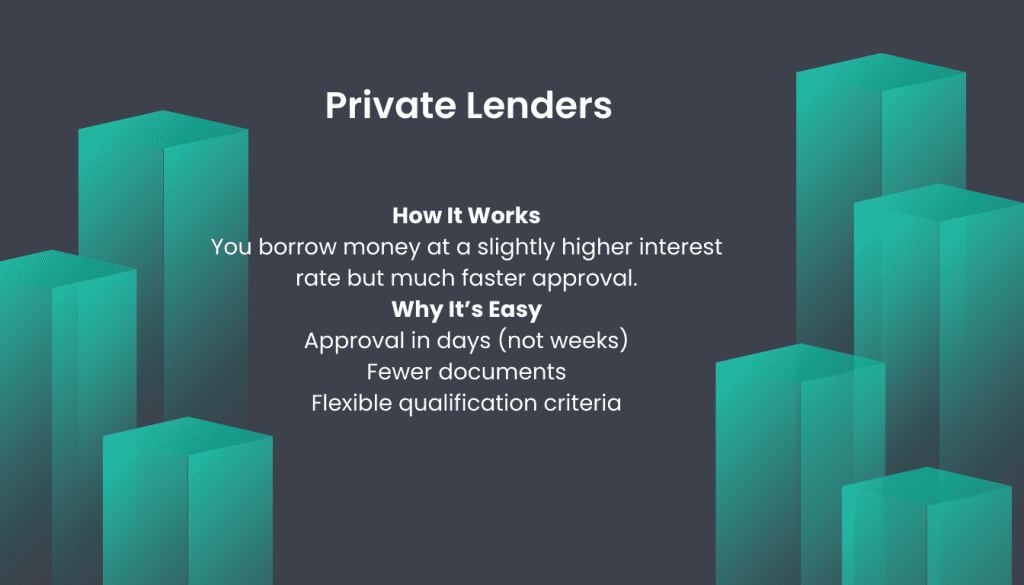
Private lenders are individuals or small companies who lend money without the strict requirements banks have.
How It Works
You borrow money at a slightly higher interest rate but much faster approval.
Why It’s Easy
- Approval in days (not weeks)
- Fewer documents
- Flexible qualification criteria
Real Example
A contractor found a discounted fixer-upper but needed funds immediately. A private lender approved his loan in four days, letting him secure the deal before anyone else.
Best For
People who have opportunities that require fast action.
5. Hard Money Loans
Hard money lenders focus on the value of the property, not your credit score.
How It Works
These loans are short-term and often used for renovation projects. They help you:
- Buy distressed homes
- Renovate quickly
- Sell or refinance afterward
Why It’s Easy
Even beginners with average credit can qualify if the deal is profitable.
Real Example
Sarah bought an old home using a hard money loan, renovated it in three months, refinanced into a cheaper mortgage, and placed a tenant inside. The rental income now pays her long-term loan.
Best For
Fix-and-flip investors or renovation-focused buyers.
6. Home Equity Loan or HELOC
If you already own a home, you might be sitting on hidden investment funds.
How It Works
You borrow money against the equity in your current home. With a HELOC, you get a flexible credit line you can use anytime.
Why It’s Easy
You don’t need to save fresh money. You simply use what you already own.
Real Example
Rakib had $120,000 equity in his primary home. He used a HELOC to fund the down payment on a rental townhouse. The rental income now covers the HELOC payments.
Best For
Existing homeowners who want a low-cost way to expand.
7. Partnerships and Joint Ventures
Real estate doesn’t have to be a solo journey.
How It Works
You partner with someone who complements your strengths.
For example:
- One partner handles money
- The other manages the renovation or tenants
Why It’s Easy
You split:
- Down payment
- Loan responsibility
- Risk
- Management tasks
Real Example
Two college friends went in together on a fourplex. One supplied the down payment; the other took care of repairs and filled vacancies. They split the profit 50/50.
Best For
Low-capital, high-skill (or the flip).
8. Rent-to-Own / Lease Option
This method allows you to control the property before owning it.
How It Works
You rent a property with the option to buy it later. Sometimes a portion of the rent goes toward the future purchase price.
Why It’s Easy
You buy time to save money or improve your credit while already controlling the home.
Real Example
A young couple rented a duplex, with the option to buy it. They moved into one unit, rented out the other and saved enough to make the purchase after two years.
Best For
People who want to prepare financially while already benefiting from rental income.
9. Real Estate Crowdfunding
An extremely low-stress way to invest in rental properties.
How It Works
You invest a small amount in large rental projects online.
Why It’s Easy
- No landlord duties
- No tenants
- No repairs
- Very low starting capital
Real Example
Nadia invested $500 into a multifamily renovation project through a crowdfunding platform. She received monthly returns without managing a single tenant.
Best For
Passive investors or those testing the real estate market.
10. The BRRRR Method
One of the fastest ways to grow a portfolio with limited money.
How It Works
- Buy an undervalued property
- Rehab it
- Rent it
- Refinance to pull out equity
- Repeat with the same money
Why It’s Easy
You don’t need multiple down payments. You recycle the same money.
Real Example
An investor bought a cheap home, renovated it, refinanced at a higher value, and used the equity withdrawal to buy a second property. In two years, he owned three rentals.
Best For
Investors inspired by the chance to do some renovation.
Final Tips for First-Time Investors
Some things to think about before opting for one funding source or another are:
✔ Your income stability
✔ Your savings
✔ Your long-term goals
✔ Your risk tolerance
✔ Local rental market demand
Start small. Learn the basics. Grow slowly.
Almost every successful real estate investor began with a single step—one property, one strategy, one decision.
Conclusion
You have a lot of options to get money for a rental property. You might use home equity, owner-occupant loans, house hacking and other strategies. Each option carries a different speed, price and level of risk.
Easy to access when you’re a homeowner: It’s easy to tap this money by using equity or owner-occupied loans. But, well, that’s you borrowing more money. Always verify rates, down payments and lender rules before you decide.
Research the area, rents, taxes and insurance. Make sure those models of cash flow are sheltered. Always have a backup plan.
Select the funding that’s right for you. If, however, you’re seeking guidance in securing loans and writing contracts, mortgage brokers abound and can assist; a lawyer who specializes in real estate transactions is worth the $1,000 to $2,500 he or she might charge (Smith; NYC Closing Costs); a C.P.A. That way, you can safely grow your investment.
FAQ
How can I raise some quick money for a rental property if I have low savings?
The easiest options are becoming an owner (owner-occupy with FHA/VA), house hack, partner, or use seller financing (these require no or little money down).
Can I purchase a rental property with no money down?
Yes, via seller financing, partnering with someone else to do the deal, assuming a mortgage or VA loan Type your answer here… or by using a HELOC to take out money for the down payment.
What credit score is needed to buy a rental property?
Most want 680–700+, but with FHA loans you can get by with much lower scores on an owner-occupied multi-unit.
First time real estate investors – What type of loan is the best?
FHA house hacking (3.5% down), conventional 20% down rentals, or using a HELOC-funded down payment are some of the best for new entrants.
Can I use HELOC for the down payment on a rental property?
Yes. Other investors borrow a HELOC on their primary residence to get the down payment, funds for renovations or closing costs.
Is cash-out refinancing to purchase an investment property a good idea?
It makes sense if you have significant equity in the home and can afford the new payment. But always compare interest rates and the cost for refinancing.
What is the best loan type for rental properties?
Nonetheless, traditional mortgages and HELOCs (used judiciously) tend to provide the perfect balance between cost, stability and long-term certainty.