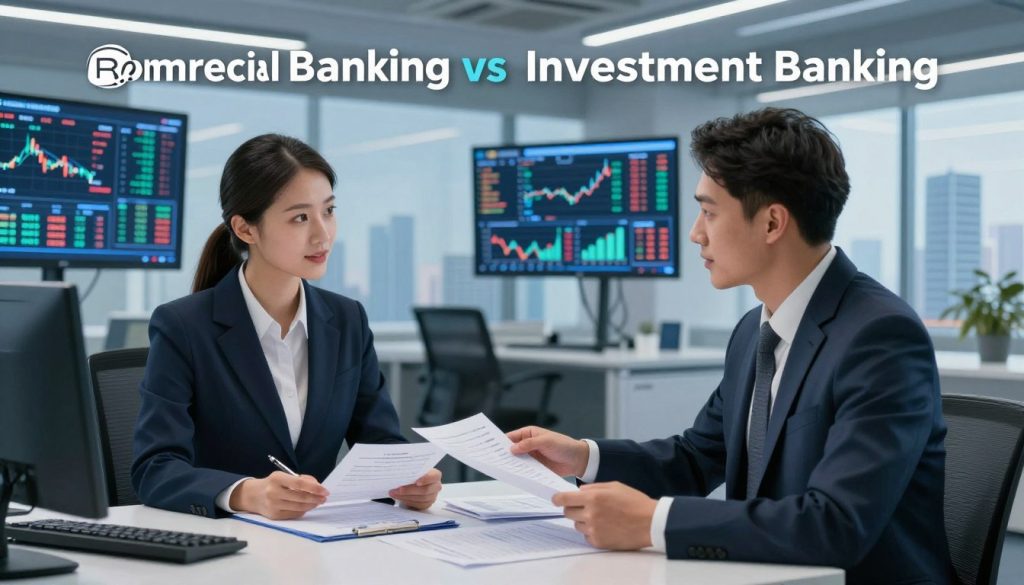
Commercial banks handle deposits, loans, and safekeeping for people and small businesses. Investment banks help with big deals, like mergers and raising capital. These roles affect their risks, how they make money, and career paths.
Big names like JPMorgan Chase, Goldman Sachs, and Morgan Stanley show how banks can do both. They offer retail services and work in capital markets. This guide helps you see which banking type meets your needs.
This article makes it easy to understand the core differences between commercial Banking vs investment banking. You’ll learn who helps everyday people and who guides big companies. We’ll look at their services, clients, and how they make money.
Key Notes;
- Commercial vs investment banking differ mainly by clients: consumers and SMEs vs corporations and institutions.
- Commercial banks earn interest and fees; investment banks earn advisory and underwriting revenue.
- Risk types differ: credit and liquidity in commercial banking, market and reputational in investment banking.
- Universal banks like JPMorgan combine both functions under different units.
- Careers vary: relationship and credit skills for commercial roles, financial modeling and deal execution for investment roles.
Overview of Commercial Banking and Investment Banking
The financial world has two main parts: routine banking and big capital markets work. This overview explains their main goals, how they’ve changed over time, and why they matter to everyone.
Definitions and core purposes
Commercial banks like Wells Fargo and Bank of America handle everyday banking. They offer checking and savings accounts, make mortgages, and lend to small and medium businesses. Their main job is to keep your money safe and help with local business loans.
Investment banks, such as Goldman Sachs and Morgan Stanley, work on big deals. They help with mergers, underwrite IPOs, and connect companies with big investors. They focus on raising capital and helping companies grow.
Historical context and the Glass-Steagall legacy
Back in the early 20th century, U.S. law made a clear difference between commercial and investment banks. The Glass-Steagall Act was made to keep savers safe and prevent big risks.
But, in the late 20th century, laws changed. Now, one bank can do both retail and investment banking. This change brought new rules and more complexity.
Why the distinction matters for individuals, businesses, and the financial system
For people, the choice affects their safety and what banking services they get. Commercial banks are key for everyday banking needs.
Businesses, on the other hand, need investment banks for big deals and capital. They use these services for IPOs, mergers, and large loans.
The banking system as a whole has different risks. Commercial banking deals with credit and liquidity risks. Investment banking handles market and underwriting risks. How we manage these risks affects the whole system.
| Aspect | Commercial Banking | Investment Banking |
|---|---|---|
| Primary clients | Consumers, small and medium enterprises, local businesses | Corporations, institutional investors, governments |
| Main services | Deposits, loans, mortgages, payment processing | Underwriting, M&A advisory, capital markets, trading |
| Revenue sources | Interest income, service fees, transaction fees | Advisory fees, underwriting spreads, trading profits |
| Dominant risks | Credit risk, liquidity risk | Market risk, underwriting risk, reputational risk |
| Regulatory focus | Deposit insurance, reserve requirements, consumer protection | Securities laws, market conduct, capital markets rules |
| Relevance to readers | Where you keep savings, obtain loans, and access everyday banking | Where companies raise capital and execute major strategic deals |
commercial banking vs investment banking
This comparison shows how commercial and investment banking differ. They have different daily tasks, clients, and what makes them money. This guide helps you understand the main differences and where they meet at big banks.
Direct side-by-side comparison of primary functions
Commercial banks handle deposits, offer checking and savings, and give out mortgages and loans. They make money from interest and fees.
Investment banks help with securities, mergers, and financial planning. They earn from fees and profits from trading.
Key client types for each
Commercial banks work with everyday people, small businesses, and local groups. They deal with a lot of simple tasks.
Investment banks work with big companies, governments, and investors. They handle complex, big deals.
How overlap appears at large universal banks
Big banks often have both types of banking under one roof. For example, JPMorgan Chase has Chase for everyday clients and JPMorgan for big deals. Citigroup has Citibank for personal banking and Citi Global Markets for big financial work.
These banks share systems and teams, which saves money. But, it can also lead to problems that need careful watching.
| Area | Commercial Banks | Investment Banks |
|---|---|---|
| Primary activities | Deposit taking, lending, retail accounts, mortgages, credit cards | Underwriting, M&A advisory, capital markets, trading |
| Typical clients | Consumers, SMEs, local businesses | Large corporations, governments, institutional investors |
| Revenue sources | Interest income, service fees, loan repayments | Advisory fees, underwriting spreads, trading gains |
| Risk profile | Credit and liquidity risk | Market, underwriting, reputational risk |
| Examples of universal bank structure | Chase retail branches and business banking | JPMorgan corporate finance and Citi Global Markets |
Services Offered by Commercial Banks
Commercial banks help both homes and businesses with many financial needs. They take deposits, keep money safe, and offer online banking. Banks like Bank of America and Citibank are trusted for their convenience and basic services.
Retail offerings include checking and savings accounts, debit and credit cards, personal loans, and mortgages. These services aim to be easy to use and follow rules to protect customers. Branch staff help with in-person needs, and tech teams keep online services safe.
Business lending offers loans for businesses, like commercial and industrial loans, lines of credit, and equipment financing. Loan officers work with businesses to meet their financial needs. Commercial banking also includes business credit cards and ways to accept payments.
Cash management and payments help with payroll, receivables, and keeping money flowing. Treasury services help move funds and settle accounts. This keeps businesses running smoothly, big or small.
Commercial banks make money from loan interest and fees from accounts and transactions. This is different from underwriting fees in capital markets, which are one-time. Big banks might also offer investment advice and asset management for clients needing both cash and wealth solutions.
Services Offered by Investment Banks
Investment banks help companies, governments, and institutions raise money. They manage complex deals. These firms use their knowledge to help both sides in the capital markets.
Underwriting is key for many deals. Banks like Goldman Sachs help companies go public or issue bonds. They buy securities and sell them to investors. This helps the issuer and connects them to investors.
Mergers and acquisitions advisory is also important. Banks like JPMorgan help plan and execute big deals. They do due diligence, value companies, and negotiate terms. This helps clients achieve their goals and deal with complex issues.
Corporate finance advice is about how to finance a company. Advisors suggest the best way to raise money. They help design financial instruments that fit a company’s needs.
Trading, sales, and research give clients market access and insights. Sales teams sell securities, traders provide liquidity, and research analysts give reports. These services help clients make informed investment decisions.
Asset and wealth management is another service. Large institutions and wealthy clients get portfolio management and custody services. These services help build long-term relationships with clients.
Investment banks have different roles. Some handle big deals, while others focus on specific areas. This diversity helps investment banking services reach more clients.
Below is a concise comparison of core services and the primary client outcomes they target.
| Service | Main Activity | Primary Client Outcome |
|---|---|---|
| Underwriting | Buy and sell new equity or debt issues | Raise capital with price and distribution support |
| Mergers & Acquisitions Advisory | Valuation, negotiation, deal execution | Successful strategic transactions and exits |
| Corporate Finance | Capital structure and refinancing solutions | Optimized funding and reduced cost of capital |
| Trading & Sales | Market making, execution, liquidity provision | Efficient access to markets and price discovery |
| Research | Equity and credit analysis, sector coverage | Actionable insights for investors and issuers |
| Asset & Wealth Management | Portfolio management and custody services | Long-term investment solutions and fiduciary care |
Revenue Models: Interest, Fees, Underwriting and Advisory
Banking revenue comes from steady interest and deal fees. Knowing how banks make money helps us see why some earn more than others.
How commercial institutions earn income
Big banks like Wells Fargo and Bank of America make money from loans and mortgages. They get steady income from small business loans, mortgages, and credit lines.
They also make money from fees. Fees for bank services, ATM use, and treasury services add up to a steady income for customers.
How investment banks earn money
Investment banks like Goldman Sachs and Morgan Stanley make money from advisory fees and underwriting spreads. They get fees for M&A work and managing IPOs or bond offerings.
Trading desks also bring in income. They make money from trading and market-making, but this income can change a lot.
Contrasting stability and volatility
Commercial banks have more stable income from interest. Investment banks make money from deals and markets, which can be more unpredictable.
Universal banks mix these types of income. JPMorgan, for example, combines lending, underwriting fees, and trading gains.
Short comparative table
| Revenue Type | Commercial Banks (example) | Investment Banks (example) |
|---|---|---|
| Interest Income | Loan and mortgage interest — Citibank | Limited; margin on financing products — Goldman Sachs |
| Fee Income | Account and transaction fees — U.S. Bank | Advisory fees for M&A — Morgan Stanley |
| Underwriting/Spreads | Rare; syndicated loan facilitation | IPO and bond underwriting fees — Bank of America Merrill Lynch |
| Trading Profits | Secondary, limited | Principal trading and market-making revenue — Goldman Sachs |
Practical examples
A small business borrows from a regional bank. They pay monthly interest, which helps the bank.
A tech firm uses an investment bank for an IPO. The bank makes money from fees, creating a big revenue spike. This shows how underwriting and lending revenue differ.
Risk Profiles and Risk Management Differences
Commercial banks and investment banks have different risk profiles. Commercial banks focus on making sure borrowers can pay back loans. They also keep deposits safe. Investment banks, on the other hand, focus on the ups and downs of the market and making deals happen.

Credit and liquidity risks in retail and corporate lending
Credit risk is big for retail and corporate loans. Banks like Wells Fargo and Bank of America use good underwriting and credit scores to reduce defaults. They also spread out their loans to manage risk.
Liquidity risk happens when lots of people want their money back at the same time. Banks keep some money aside, have liquid assets, and have plans for emergencies to handle these situations.
Market, underwriting, and reputational risks for capital markets activity
Market risk is key for trading desks at Goldman Sachs and Morgan Stanley. Fast changes in stock and bond prices can cause big losses. Banks use models and scenarios to watch their risks.
Underwriting risk comes from buying securities to sell later. If these deals don’t work out, it can lead to losses and hurt trust with clients.
Risk controls, capital requirements, and stress testing approaches
Regulations shape how banks manage risks. Commercial banks follow rules to keep deposits safe and pass stress tests. They focus on keeping depositors safe.
Investment banks have their own rules, including SEC and FINRA standards. They use advanced models and daily risk checks to handle their volatile books.
Stress testing is common for both. Banks test how they would do under different scenarios. This helps them decide on capital, trading limits, and emergency plans.
| Risk Area | Commercial Banking (example) | Investment Banking (example) |
|---|---|---|
| Primary exposures | Credit risk from loans; liquidity risk from deposits (JPMorgan Chase) | Market risk from trading; underwriting risk from syndications (Goldman Sachs) |
| Core controls | Underwriting standards, diversification, reserve buffers, loan loss provisions | VaR, stress testing for trading books, position limits, deal committees |
| Regulatory focus | FDIC safeguards, reserve rules, supervisory stress testing | SEC/FINRA oversight, capital rules under Basel frameworks |
| Typical stress tests | Liquidity runoff scenarios; default rate shocks; interest-rate stress | Market crash scenarios; extreme volatility; counterparty default simulations |
| Reputational impact | Loan losses can erode customer confidence and deposit levels | Failed deals or trading scandals can damage fee pipelines and client relationships |
Regulation and Compliance: Contrasts and Convergence
Regulations guide how banks work, protect customers, and handle risks. This part looks at the main rules for banks and firms that deal with securities. It also talks about how changes after Glass-Steagall brought new rules for banks that do everything.
Regulation for deposit-taking banks
Commercial banks have rules to keep depositors safe and the payment system working. The FDIC covers deposits and checks on banks in trouble. They also follow rules on reserves, capital, and protecting consumers.
Regulation for securities and market activity
Firms that sell securities or act as broker-dealers follow the SEC and groups like FINRA. They focus on telling the truth, fair practices, and reporting trades. Investment banks also have to follow rules to keep the market safe.
Convergence after Glass-Steagall
After Glass-Steagall was repealed, many banks could offer more services. Banks like JPMorgan Chase and Citi grew by doing more things. This raised questions about how to manage different rules and keep things fair.
New rules came after 2008. The Dodd-Frank Act, the Volcker Rule, and Basel III made banks hold more capital. Regulators now watch over big banks more closely to prevent big problems.
How firms meet dual obligations
Big banks have special rules for their consumer and investment banking sides. They work together to make sure everyone follows the same rules. They use checks and balances to meet both the FDIC and SEC rules.
| Area | Commercial Bank Focus | Investment Bank Focus |
|---|---|---|
| Primary regulator | FDIC, Federal Reserve, OCC | SEC, FINRA |
| Main regulatory goals | Deposit protection, liquidity, credit quality | Market integrity, disclosure, investor protection |
| Key rules and standards | Reserve requirements, capital ratios, consumer laws | SEC disclosure rules, broker-dealer capital, conduct rules |
| Compliance tools | Liquidity stress tests, loan underwriting standards | Trade surveillance, suitability checks, prospectus controls |
| Post-Glass-Steagall impact | Need for stronger enterprise controls | Integration with prudential oversight for systemic firms |
| Examples | Wells Fargo retail operations, FDIC insurance programs | Goldman Sachs underwriting desks, SEC filings |
Daily Operations and Organizational Structure
Banks have different daily routines based on their size and focus. Retail branches deal with everyday customer needs. Trading floors, on the other hand, move fast with market changes.
A clear structure is key. It keeps tasks in order, lowers risks, and helps serve clients well in both areas.
Typical roles and teams in commercial banks
Retail banking is all about serving customers. Tellers and branch managers handle money and sales. Loan officers and credit underwriters work on loans.
Trust officers and relationship managers help with wealth and small business needs.
Typical roles and teams in investment banks
Investment banking is about big deals and market moves. Analysts and associates create financial plans. Mergers & acquisitions bankers work on deals.
Trading desks, sales teams, and research analysts help clients and execute trades.
How back-office, IT, and compliance functions overlap
Bank operations rely on shared support. Back-office teams settle and clear transactions. IT keeps online banking and systems running.
Legal, risk, and compliance teams follow rules and check controls.
At big banks like JPMorgan Chase and Citigroup, shared services save money. But front-office teams focus on their special areas. This mix makes banking efficient and meets many client needs.
Careers and Skills: Banking Careers in Commercial vs Investment Banking
Banking careers vary by function and client focus. They start at the teller window and grow to leadership. Choices affect daily tasks and future opportunities.

Common career paths and credentials
Commercial banking starts as tellers or loan officers. Midlevel roles include commercial lending specialists. Senior roles are in regional management and credit leadership.
Investment banking starts as analysts and moves to associates and vice presidents. It focuses on M&A, capital markets, and trading. A finance or economics degree is key, with MBAs valued for senior roles.
Skill differences and learning paths
Commercial banking needs credit assessment and relationship management. It requires knowledge of loan structuring and regulatory compliance. CFP and CPA add value for client advisory and treasury roles.
Investment banking demands fast financial modeling and valuation. Excel and PowerPoint skills are essential. An MBA can speed up career advancement in deal leadership.
Work culture, compensation, and mobility
Work hours and pay vary by sector. Investment banking has long hours and high bonuses. Commercial banking offers steadier hours and relationship rewards.
Moving between sectors requires upskilling. A relationship manager needs modeling skills for investment roles. An analyst can move to commercial credit with CFP certification.
Career checklist
- Identify target role: teller, loan officer, analyst, or trader.
- Match education: bachelor’s for entry, MBA for leadership.
- Consider certifications: CFA for investment and research, CFP for financial planning roles.
- Build skills: modeling for investment; credit and relationship work for commercial.
- Network through internships and professional associations.
| Aspect | Commercial Banking Careers | Investment Banking Careers |
|---|---|---|
| Typical entry roles | Teller, Loan Officer, Branch Staff | Analyst, Junior Associate, Research Assistant |
| Key skills | Credit assessment, client relations, regulatory knowledge | Financial modeling, valuation, deal structuring |
| Common credentials | Bachelor’s, CFP, CPA for advisory paths | Bachelor’s, MBA, CFA for asset management and research |
| Work culture | Client-focused, steadier hours, regional presence | Deal-driven, long hours, high-pressure environment |
| Compensation pattern | Stable salary, performance bonuses, benefits | Higher base and large bonus tied to deals |
| Mobility tips | Develop credit modeling and CFP for advisory shifts | Gain relationship management and commercial lending exposure |
Real-World Examples and Scenarios Showing Client Interactions
This section shows how commercial banks and investment banks meet different needs. It uses well-known banks to explain their roles clearly.
Individual consumer scenario:
A person goes to Wells Fargo for a mortgage. A loan officer asks for income and credit reports. The bank checks if the loan is safe and then funds it.
This shows how commercial banks make money from loans and interest.
Company growth scenario:
A tech company hires Goldman Sachs for its IPO. Goldman Sachs values the company, prepares documents, and sets a price. They also manage the sale of shares.
This shows how investment banks make money from big deals.
Hybrid example at universal banks:
A company uses JPMorgan Chase for its daily banking. It also works with JPMorgan’s investment team for big loans. This mix of services helps the company.
But, it also means the bank has to be careful to protect everyone.
Comparative view:
Here’s a quick look at what each type of bank does. It shows how they serve the same clients but in different ways.
| Category | Commercial Banking | Investment Banking |
|---|---|---|
| Core Services | Deposits, checking, savings, loans, mortgages | Underwriting, IPO advisory, M&A advisory, capital markets |
| Typical Clients | Consumers, small and medium enterprises, some corporates | Large corporations, institutional investors, private companies |
| Primary Revenue | Interest income from loans, account fees, service charges | Advisory fees, underwriting spreads, trading profits |
| Dominant Risks | Credit risk, liquidity risk, operational risk | Market risk, underwriting risk, reputational risk |
| Example Scenario | Mortgage example: underwriting and long‑term loan servicing | IPO advisory: valuation, SEC filings, syndication |
| When Both Apply | Cash management and lending to the same corporate client | Debt issuance or M&A advisory for that corporate client |
Conclusion
Commercial banking and investment banking are two different things. Commercial banks handle everyday banking needs like deposits and loans for small businesses. On the other hand, investment banks help big companies with things like IPOs and mergers.
The Glass-Steagall Act changed how banks work. Now, banks like JPMorgan Chase do both kinds of banking. This makes things more efficient but also more complicated.
Commercial banks focus on keeping money safe and lending to people and small businesses. Investment banks deal with risks and making deals for big companies. Knowing the difference helps you choose the right bank for your needs.
FAQ
Is JP Morgan a commercial bank or investment bank?
JPMorgan Chase does both. Chase Bank offers services for consumers and businesses. It handles deposits, loans, and payments.
On the other hand, JPMorgan focuses on investment banking. It advises on mergers and underwrites securities. So, JP Morgan is both a commercial and investment bank.
Is investment banking part of commercial banking?
Big banks do both. After Glass-Steagall was repealed, many banks added investment banking. This makes the question complex.
Investment banking is a separate function. It has its own clients, risks, and rules. Even if it’s part of a commercial bank, it’s different.
Morgan Stanley commercial or investment bank?
Morgan Stanley started as an investment bank. It focuses on underwriting, advisory, trading, and wealth management. It serves high-net-worth and institutional clients.
Over time, Morgan Stanley added wealth and lending services. But it’s mainly known as an investment bank. It’s not like Chase or Citibank, which do more retail banking.